Andrew Wyeth
Andrew Wyeth was an American painter known for closely observed landscapes, interiors, and people from Chadds Ford, Pennsylvania, and coastal Maine.
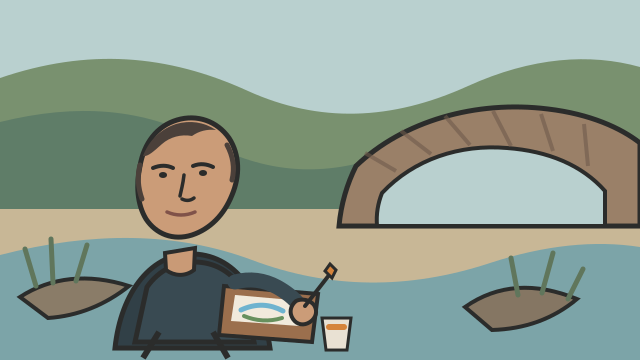
Painter
James Gurney is an American painter, illustrator, and author known for imaginative realism, outdoor sketching, and traditional painting media.
Gurney’s quick facts cover imaginative realism, illustration, outdoor sketching, and the traditional media documented in his painting practice.
| Full name | James Gurney |
|---|---|
| Born | 1958 · California, U.S. |
| Died | — |
| Nationality | American |
| Movements | Imaginative Realism |
| Paint types | Casein · Gouache · Watercolor · Oil paint |
| Other media | — |
| Other materials | — |
| Painting surfaces | Paper · Painting board · Canvas · Cardboard · Foam board · prepared Styrofoam maquettes |
| Painting methods | Plein-air observation, portable painting setups, and maquette-based imaginative realism |
| Common subjects | Plein-air scenes, dinosaurs, imagined worlds, landscapes, architecture, and observational studies |
| Notable works | Dinotopia · Casein Painting in the Wild |
Sources: About James Gurney, Casein Painting in the Wild, Gurney Journey: Architectural Maquettes, Gurney Journey: How Should You Paint a Maquette?, Gurney Journey: prepared Styrofoam domes and acrylic-painted maquettes, Gurney Journey: Impromptu Oil Portrait, and Gurney Journey: Painting Clouds Over a Sky Gradation.
Gurney uses casein, gouache, watercolor, and oil for different field studies and illustrations, with published notes documenting specific processes.

Gurney documents painting outdoors from life with casein, a quick-drying, matte medium suited to compact field studies. He uses it to record color and value while working on location, where a painting can be completed before the light or weather changes. These observations are distinct from his more transparent watercolor notes.

Gurney uses gouache for opaque color studies, including compact field work in which solid passages can be layered over earlier marks. Its coverage differs from the transparent washes in his watercolors, while the medium’s portability suits the same outdoor practice of observing changing light and color.

Gurney’s field practice also includes transparent watercolor studies of landscapes, skies, and changing conditions outdoors. He uses the paper’s light ground and fluid washes to record broad color relationships quickly; this method differs from the opaque coverage of gouache and the matte finish of casein.

Gurney paints portrait studies in oil, including documented impromptu sessions from life. Oil allows him to work into the image with more sustained modeling than his quick outdoor casein or watercolor notes. His portrait practice shows a different use of paint from the imaginative environments and reference models in his illustration work.
Sources: James Gurney: casein painting in the field, Gurney Journey: architectural maquettes, Gurney Journey: painting maquettes, Gurney Journey: Impromptu Oil Portrait, and Gurney Journey: watercolor sky gradation.
Collection entries identify paper and painting board among James Gurney’s supports, with the examples below grounding each material in documented works.

Gurney uses paper for watercolor and gouache field studies made outdoors. He records color, light, and atmosphere directly from observation, with the sheet serving as a portable support for fluid washes and opaque additions. These small studies are separate from his larger oil portraits and studio paintings.

Gurney paints on rigid board for finished casein pictures and studies. Its stable surface suits his compact, matte casein work and can be carried into the field more easily than a large stretched canvas. His documented practice connects the board to both observational studies and resolved paintings.

Gurney also uses canvas for oil and acrylic paintings. These supports appear in finished studio works and portraits, rather than only the portable field studies he makes on paper or board. The records distinguish his larger paintings from small observations made outdoors.

Gurney has used cardboard for portable studies and demonstrations, making use of an inexpensive rigid sheet for paint tests and observational work. These examples belong to his practical working process and should not be generalized to every finished painting. The sources identify it as a working surface rather than a finished canvas.

Foam board appears in Gurney’s documented studio and presentation work as a lightweight rigid support. He uses it when a flat, portable panel suits a study or demonstration; the material is distinct from the composition board and canvas documented for other paintings.

Gurney paints prepared Styrofoam maquettes as reference models for imagined buildings and scenes. The painted foam is a three-dimensional working surface used to study light and color on a form, not a conventional flat support for a finished painting. This distinguishes the maquette from his finished paintings.
Sources: About James Gurney, Casein Painting in the Wild, Gurney Journey: Architectural Maquettes, Gurney Journey: How Should You Paint a Maquette?, Gurney Journey: prepared Styrofoam domes and acrylic-painted maquettes.
Explore painters linked to Gurney through observational realism, outdoor painting, watercolor and traditional media, and practical painting technique.
Andrew Wyeth was an American painter known for closely observed landscapes, interiors, and people from Chadds Ford, Pennsylvania, and coastal Maine.
Winslow Homer was an American painter and illustrator whose scenes of the sea, rural life, and people in demanding settings span oil and watercolor.

Koo Schadler is an American painter known for egg tempera, metalpoint drawings, works on prepared paper and rigid panels, and teaching traditional methods.