
Oil Paint
Oil paint is a slow-drying art medium made with pigment and a drying-oil binder that allows extended working time, smooth blending, and layered application.
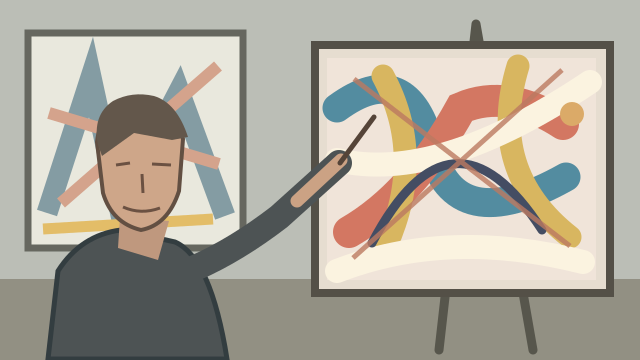
Painter
Willem de Kooning was a Dutch-born American Abstract Expressionist known for vigorous oil brushwork, shifting figures, and boldly colored abstract paintings.
De Kooning repeatedly worked between painted figures and abstraction, revising compositions through energetic brushwork, scraping, and overpainting.
| Born | 1904 · Rotterdam, Netherlands |
|---|---|
| Died | 1997 · East Hampton, New York, United States |
| Nationality | Dutch-born American |
| Movements | Abstract Expressionism; New York School |
| Paint types | Oil Paint · Enamel Paint |
| Painting surfaces | Canvas · Paper |
| Painting methods | Broad, forceful brushwork, scraping, revisions, and layered paint that alternates between figurative motifs and gestural abstraction |
| Common subjects | Women, urban landscapes, highways, abstract forms, and the Long Island landscape |
| Notable works | Woman I · Pink Angels · Excavation · …Whose Name Was Writ in Water |
| Other materials | Charcoal and metallic paint in documented paintings; oil on paper sometimes mounted on rigid supports |
Sources: MoMA: de Kooning retrospective, MoMA: Woman I, MoMA: Woman, enamel on paper, Guggenheim: Untitled, oil on paper, Guggenheim: …Whose Name Was Writ in Water.
Oil paint was central to de Kooning's canvases; MoMA also documents enamel in a work on paper and metallic paint in Woman I.
Oil paint is a slow-drying art medium made with pigment and a drying-oil binder that allows extended working time, smooth blending, and layered application.

Enamel paint is a broad coating category formulated to produce a durable finish, with modern products available in both oil-based and water-based systems.
De Kooning painted major works on canvas and oil studies on paper, sometimes mounting the painted paper onto Masonite or wood for support.

Canvas is a woven fabric support, commonly cotton or linen, used for painting and sold either raw or prepared with a compatible ground layer.

Paper is an absorbent sheet material made from pressed fibers, with weight, sizing, and surface texture controlling moisture tolerance and paint behavior.
Pollock and de Kooning were leading New York School painters, while Rothko developed a contrasting, quieter form of postwar abstraction.
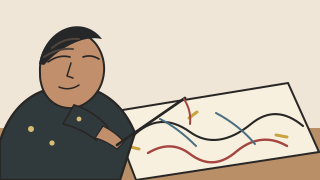
Jackson Pollock was an American Abstract Expressionist known for pouring, dripping, and flinging fluid paint across canvases laid on the floor.
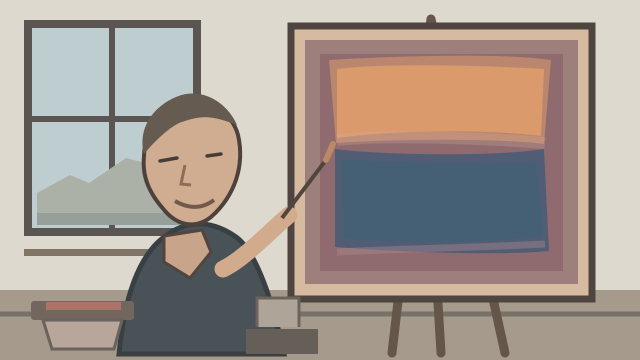
Mark Rothko was an American abstract painter known for large canvases with softly edged fields of color and a focus on the emotional impact of painting.