
Fluorescent Paint
Fluorescent paint uses highly vivid pigments that appear especially bright under strong light and ultraviolet illumination. Unlike glow-in-the-dark paint, it does not continue glowing after the light source is removed.

Painter
Ushio Shinohara is a Japanese artist known for action-based painting, Neo-Dada and Pop experimentation, and works using fluorescent Day-Glo color, lacquer, oil, enamel, acrylic, and unconventional materials.
Shinohara belonged to Japan’s Neo-Dada Organizers, whose anti-art performances echoed the earlier Dada movement. His paintings also used fluorescent color and industrial materials.
| Born | 1932 · Tokyo, Japan |
|---|---|
| Died | — |
| Nationality | Japanese |
| Movements | Neo-Dada and Pop Art |
| Paint types | Fluorescent paint · Lacquer paint · Oil paint · Enamel paint · Acrylic paint |
| Painting surfaces | Canvas · Fabric · Paper · Cardboard · Plywood · Wood · Plastic |
| Painting methods | Action painting, Boxing Painting, assemblage, imitation and parody, Neo-Dada, and Pop-inspired work |
| Common subjects | Popular culture, mass-media imagery, urban energy, performance, and the exchange between Japanese and American art |
| Known for | Combining physical performance and vivid commercial materials with irreverent responses to postwar art and popular culture |
| Notable works | P38 · Oiran · Motorcycle Mama · Gutai and Neo-Dada |
Sources: Museum of Modern Art, MoMA Post: Shinohara Ushio's dialogue with American art, Art Platform Japan: P38, Art Platform Japan: Subway Entrance, Art Platform Japan: Oiran, Tochigi Digital Museum: Motorcycle Mama, Yokohama Museum of Art: Gutai and Neo-Dada, and Tokyo Gallery: Untitled (1961).
See the paint types documented in Shinohara's work, with links to PaintZeal references explaining each medium's properties, uses, and working characteristics.
Fluorescent paint uses highly vivid pigments that appear especially bright under strong light and ultraviolet illumination. Unlike glow-in-the-dark paint, it does not continue glowing after the light source is removed.
Lacquer paint is a fast-drying coating designed to form a smooth and hard finish. It is commonly used on furniture and woodwork as well as some metal surfaces.

Oil paint is a slow-drying paint made with pigment and a drying oil binder. It is widely used for artwork because it blends smoothly and develops rich color.

Enamel paint is a broad category of coatings designed to form a hard and durable finish. Modern enamels may use either oil-based or water-based binders.
Acrylic paint is a fast-drying, water-based paint made with pigment and an acrylic polymer binder. It is widely used in art and decorative projects because it is versatile and durable.
See the surface types documented in Shinohara's work, with links to PaintZeal references explaining how each support behaves and is prepared for painting.
Canvas is a woven fabric used as a flexible support for painting. Artist canvas is commonly made from cotton or linen and sold either raw or coated with a ground layer.

Fabric is a flexible material made by weaving, knitting, or bonding fibers. Its fiber content, texture, stretch, and washability affect how paint bonds and wears.

Paper is an absorbent sheet material made from pressed fibers. Its weight, sizing, and surface texture determine how much moisture it can handle and how paint spreads.

Cardboard is a paper-based sheet material made from compressed fibers, often with corrugated fluting between liner sheets. It is lightweight and absorbent, so heavy wet coats can soften or warp it.
Plywood is an engineered wood panel made from bonded veneer layers with alternating grain, and its faces, edges, and filled areas absorb paint differently.
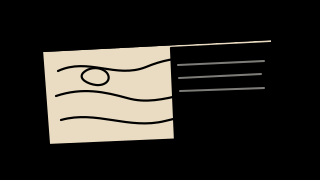
Wood is a natural, porous material with grain patterns and absorbency that vary by species and cut. Its surface may also contain knots, resin, or an existing finish.

Plastic is a broad family of synthetic materials that can be rigid or flexible. Its smooth surface and varying chemical composition make paint compatibility highly material-specific.
Explore painters similar to Ushio Shinohara through action painting, physical process, vivid commercial color, lacquer, and postwar experiments with unconventional materials.
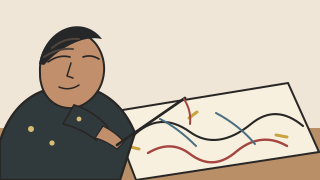
Jackson Pollock was an American Abstract Expressionist known for pouring, dripping, and flinging fluid paint across canvases laid on the floor.

Billy Al Bengston was an American painter associated with postwar Los Angeles who adapted automotive lacquer, enamel, aluminum, and high-gloss finishing methods to fine-art painting.

Andy Warhol was an American Pop artist known for transforming consumer products, celebrities, and mass-media photographs into paintings and repeated screen-printed images.