
Tschabalala Self
Tschabalala Self builds figurative paintings from paint, printed imagery, and sewn fabric, using material collage to depict Black life and identity.

Painter
Sarah Crowner is an artist known for sewn paintings in linen and cotton, works on paper, and glazed-tile projects that extend abstraction into space.
Crowner combines painted and sewn fabric, paper, and glazed tile, linking geometric abstraction with installation and performance across supports.
| Full name | Sarah Crowner |
|---|---|
| Born | 1974 · Philadelphia, Pennsylvania, U.S. |
| Died | — |
| Nationality | American |
| Movements | Contemporary abstraction |
| Paint types | Acrylic paint |
| Other media | — |
| Other materials | — |
| Painting surfaces | Canvas · Linen · Cotton · Paper · Tile |
| Painting methods | Painted and raw fabric sections are cut, arranged, and stitched together; visible seams remain part of the composition |
| Common subjects | Geometric abstract shapes, curves, and architectural space |
| Notable works | Curtains (Vidas perfectas) · Sliced Greens (for Tegucigalpa) · Two Tigers |
Sources: Whitney Museum of American Art, Museum of Fine Arts Boston: Curtains (Vidas perfectas), U.S. Department of State: Sarah Crowner, Galerie Max Hetzler: selected works, MASS MoCA: Beetle in the Leaves, Moody Center for the Arts, and The Chinati Foundation.
Records document Sarah Crowner’s use of acrylic paint; examples below connect the medium to named works and explain its role in her sewn compositions.
The Guggenheim catalogs acrylic on canvas in Crowner’s Totem, together with unpainted canvas and thread. The record documents painted and sewn parts within the same work, showing how acrylic participates in her shaped geometric compositions without reducing the canvas construction to a conventional rectangle.
Sources: Solomon R. Guggenheim Museum: Sarah Crowner collection, Museum of Fine Arts, Boston: Curtains (Vidas perfectas).; Whitney Museum: Sarah Crowner; MASS MoCA: Sarah Crowner
Documented works by Sarah Crowner use Linen and Cotton, with examples clarifying when a material is painted ground, backing, or part of a constructed work.

Crowner’s paintings use linen, with shaped and stitched supports central to her practice. She cuts, joins, and sews panels so the seams and textile surfaces help determine the composition, making linen both a painted support and a structural element. The material record identifies the textile used in the finished work.

Crowner has painted on cotton fabric and canvas, often sewing or joining panels. The woven material remains visible within her geometric constructions, distinguishing her supports from smooth board or paper and linking painting to textile processes. The material record identifies the textile used in the finished work.

Crowner uses fabric and sewn materials as painted supports, cutting and assembling cloth into geometric forms. Stitching, folds, and seams shape the image as much as the painted color, so the flexible textile remains visible in the finished work. The material record identifies the textile used in the finished work.
Her canvases are frequently cut, joined, or assembled into shaped geometric compositions. The Guggenheim’s Totem records acrylic with unpainted canvas and thread, showing how the fabric support and sewing are integrated into the painted work. The collection entry identifies canvas as the work’s immediate support.

Paper supports Crowner’s drawings and selected painted studies, providing a flat, portable surface distinct from the shaped, sewn fabric constructions. These sheets allow her to explore geometry and color before or alongside the larger assembled works. The collection record names the sheet as the work’s documented support.
Crowner also paints on tile, translating geometric patterns onto ceramic surfaces. The rigid, glazed support differs from her flexible sewn canvases, carrying the design onto a small, hard plane. Exhibition records document tile in selected works. The work preserves the ceramic surface beneath its design.
Sources: Whitney Museum of American Art, Museum of Fine Arts Boston: Curtains (Vidas perfectas), U.S. Department of State: Sarah Crowner, Galerie Max Hetzler: selected works, MASS MoCA: Beetle in the Leaves.
Crowner's sewn fabric and geometric forms connect her to artists who build paintings from mixed media and extend them beyond stretched canvas.
Tschabalala Self builds figurative paintings from paint, printed imagery, and sewn fabric, using material collage to depict Black life and identity.

Molly Zuckerman-Hartung is an American painter whose abstractions combine commercial paints with cut fabric, sewn supports, paper, and studio materials.
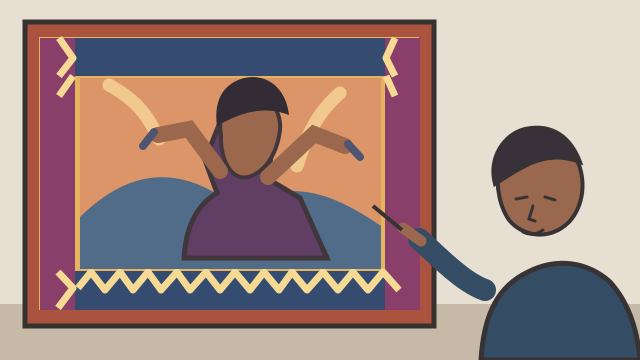
Emma Amos was an American painter whose oil and acrylic figures on canvas often incorporate handwoven textiles and African fabric borders in many works.
Amy Sillman is an American painter known for layered oil and acrylic paintings that move between abstraction and figuration through drawing and revision.
Dona Nelson is an American painter who builds two-sided acrylic canvases with poured color, stitched string, dyed fabric, and paint seepage.
Faith Ringgold was an American painter whose oil paintings and acrylic story quilts combine fabric, painted canvas, and Black American narratives.