
Oil Paint
Oil paint is a slow-drying art medium made with pigment and a drying-oil binder that allows extended working time, smooth blending, and layered application.

Painter
José Clemente Orozco was a Mexican muralist whose dramatic frescoes and paintings examined revolution, human suffering, political conflict, and social change.
Orozco's murals frequently took a darker, more skeptical view of revolutionary violence than Rivera's. His surviving paintings demonstrate distinct media beyond fresco.
| Born | November 23, 1883 · Zapotlán el Grande (now Ciudad Guzmán), Jalisco, Mexico |
|---|---|
| Died | September 7, 1949 · Mexico City, Mexico |
| Nationality | Mexican |
| Movements | Mexican Muralism |
| Paint types | Oil paint · gouache · tempera · fresco pigments on damp plaster |
| Painting surfaces | Plaster for fresco murals · canvas · cardboard |
| Painting methods | Architectural fresco painting on plaster; strong graphic outlines, dramatic figure groupings, and contrasting dark and fiery colors |
| Common subjects | Revolution, conflict, suffering, allegory, labor, machines, and the contradictions of modern life |
| Notable works | Prometheus (1930) · Zapatistas (1931) · The Epic of American Civilization (1932–34) |
Sources: MoMA: Zapatistas, Pomona College: Orozco and Prometheus, Smithsonian: 1940 Self-Portrait, Smithsonian: 1946 Self-portrait, Saint Louis Art Museum: Artist record.
MoMA records Zapatistas as oil on canvas, while a Smithsonian catalog documents oil and gouache on cardboard in a 1940 self-portrait and tempera on canvas in a 1946 self-portrait. His murals used fresco rather than these portable-painting formulas.
Oil paint is a slow-drying art medium made with pigment and a drying-oil binder that allows extended working time, smooth blending, and layered application.

Gouache paint is an opaque, water-based art medium made with pigment and a water-soluble binder, drying to a matte finish that can be reactivated with water.

Traditional tempera is an artist paint made from pigment and an emulsion binder, with egg yolk the best-known binder among several historical formulations.
Orozco's monumental fresco cycles were painted on plaster architecture, while museum-held easel paintings and self-portraits document both canvas and cardboard supports.

Plaster is a mineral wall finish made from gypsum, lime, cement, or similar binders, with porosity and moisture content changing as the material cures and dries.

Canvas is a woven fabric support, commonly cotton or linen, used for painting and sold either raw or prepared with a compatible ground layer.

Cardboard is a lightweight, absorbent paper-based sheet material whose fibers and corrugated layers can soften or warp when exposed to heavy wet coats.
Rivera and Siqueiros shared Orozco's Mexican Muralist context, but developed different narrative emphases and approaches to materials.
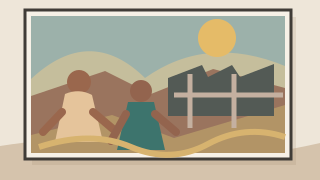
Diego Rivera was a Mexican painter and muralist whose frescoes depicted workers, industry, national history, and everyday life on monumental public walls.

David Alfaro Siqueiros was a Mexican painter and muralist known for using industrial materials and methods, including lacquer, enamel, pyroxylin, and automotive coatings.