
Oil Paint
Oil paint is a slow-drying paint made with pigment and a drying oil binder. It is widely used for artwork because it blends smoothly and develops rich color.

Painting Movement
Mexican Muralism transformed large public walls into ambitious narratives of Mexican history, community, labor, and political change.
A post-revolutionary public-art movement led by Mexican mural painters, often called the Mexican muralist movement.
| Origin | Mexico, after the Mexican Revolution |
|---|---|
| Approximate period | 1920s–1950s (major public programs; later influence) |
| Historical context | Developed after the Mexican Revolution; public commissions brought national history and political subjects to a wide audience |
| Other name | Mexican muralist movement; not the same as all twentieth-century Mexican painting |
| Defining features | Monumental figures, allegory, dynamic compositions, public storytelling, Indigenous history, and workers' experiences |
| Central muralists | Diego Rivera, José Clemente Orozco, and David Alfaro Siqueiros, often called the Big Three |
| Methods and materials | Traditional fresco painting on wet lime plaster alongside experimental industrial media, depending on painter and commission |
| Important murals | Rivera's Detroit Industry Murals, Orozco's The Epic of American Civilization, and Siqueiros's public murals |
| Relationship to Social Realism | Both addressed labor and society; Mexican Muralism specifically emphasized monumental public painting in post-revolutionary Mexico |
| Painting surfaces | Primarily prepared architectural walls and plaster; artists also painted portable works on canvas and panel |
Sources: National Gallery of Art: José Clemente Orozco, National Gallery of Art: Mexican muralists and the Great Depression.
Muralists worked in fresco and sometimes industrial coatings, while modern acrylics and other paints can reinterpret the movement's bold shapes and public-scale imagery. Fresco is a plaster-painting technique, not a paint type.
Oil paint is a slow-drying paint made with pigment and a drying oil binder. It is widely used for artwork because it blends smoothly and develops rich color.

Acrylic paint is a fast-drying, water-based paint made with pigment and an acrylic polymer binder. It is widely used in art and decorative projects because it is versatile and durable.

Lacquer paint is a fast-drying coating designed to form a smooth and hard finish. It is commonly used on furniture and woodwork as well as some metal surfaces.

Enamel paint is a broad category of coatings designed to form a hard and durable finish. Modern enamels may use either oil-based or water-based binders.

Spray paint is a liquid coating packaged in a pressurized can and applied as a fine aerosol rather than with a brush or roller.

Gouache paint is an opaque, water-based art medium made with pigment and a water-soluble binder, drying to a matte finish that can be reactivated with water.

Casein paint is a water-based paint that uses milk protein as its binder, dries quickly to a matte finish, and becomes more water-resistant as it cures.
Rivera, Orozco, and Siqueiros are the core muralists. Frida Kahlo was a major Mexican modern painter, but was not a central member of this mural-painting group.
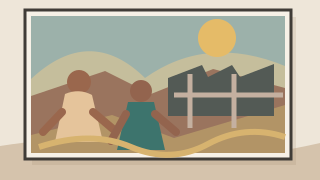
Diego Rivera was a Mexican painter and muralist whose frescoes depicted workers, industry, national history, and everyday life on monumental public walls.

José Clemente Orozco was a Mexican muralist whose dramatic frescoes and paintings examined revolution, human suffering, political conflict, and social change.

David Alfaro Siqueiros was a Mexican painter and muralist known for using industrial materials and methods, including lacquer, enamel, pyroxylin, and automotive coatings.
Like nineteenth-century Realism and German New Objectivity, Mexican muralists confronted contemporary life, but used large public walls and Mexican historical narratives as defining features.
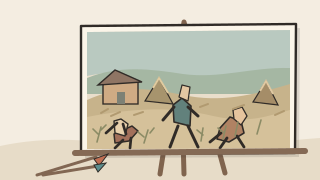
Realism emerged in nineteenth-century France as painters depicted ordinary people, rural labor, and contemporary life without idealization or heroic subjects.

New Objectivity developed in 1920s Germany as painters turned to unsentimental portraits and sharp observations of life during the Weimar Republic.

Social Realism portrayed ordinary workers, hardship, and inequality through accessible images intended to engage a broad public.