
Oil Paint
Oil paint is a slow-drying paint made with pigment and a drying oil binder. It is widely used for artwork because it blends smoothly and develops rich color.
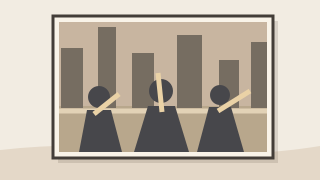
Painting Movement
Social Realism portrayed ordinary workers, hardship, and inequality through accessible images intended to engage a broad public.
Social Realism portrayed workers, inequality, and hardship through accessible art, distinct from Soviet state-directed Socialist Realism and earlier nineteenth-century Realism.
| Origin | International, especially during the interwar period |
|---|---|
| Approximate period | 1920s–1940s (later influence) |
| Historical setting | Economic hardship, labor conflicts, and social upheaval between the world wars |
| Main subjects | Workers, families, poverty, social inequality, and community struggle |
| Important distinction | Not interchangeable with Socialist Realism, a state-directed official Soviet aesthetic |
| Painting methods | Readable figures, strong outlines, and varied approaches to casein, tempera, watercolor, and oil |
| Associated painters | Ben Shahn, Jacob Lawrence, Diego Rivera, and David Alfaro Siqueiros worked within overlapping socially engaged traditions |
| Relationship to Mexican Muralism | Shares social aims but includes smaller paintings, prints, and work outside Mexico; not all social-realist work is mural painting |
| Surfaces | Canvas, paper, wood and mural walls depending on the artist and project |
Sources: MoMA: Social Realism, National Gallery of Art: The Great Depression.
Oil, tempera, casein, gouache, and watercolor suit bold figurative storytelling and clear contours, with acrylics providing a flexible modern option.
Oil paint is a slow-drying paint made with pigment and a drying oil binder. It is widely used for artwork because it blends smoothly and develops rich color.

Modern tempera is an opaque, water-based art paint used for school and craft projects, drying quickly and differing from traditional egg tempera.

Casein paint is a water-based paint that uses casein, a milk protein, as its binder. It dries quickly to a matte film and becomes increasingly water-resistant as it cures.

Gouache paint is an opaque, water-based art medium made with pigment and a water-soluble binder. Traditional formulas dry to a matte finish and can be reactivated with water.

Watercolor paint is a water-based art medium made with pigment and a water-soluble binder. It is known for transparent color that settles into absorbent paper.

Acrylic paint is a fast-drying, water-based paint made with pigment and an acrylic polymer binder. It is widely used in art and decorative projects because it is versatile and durable.

Acrylic gouache is an opaque acrylic paint that dries to a flat matte finish while forming a permanent, water-resistant film unlike traditional gouache.
These painters engaged with social conditions in distinct ways; Social Realism was not a single membership organization.

Ben Shahn was an American painter and graphic artist known for socially engaged imagery, expressive line, and paintings made with tempera.

Jacob Lawrence was an American painter known for vivid narrative series about Black life and history, especially The Migration Series, created with quick-drying tempera on hardboard panels.
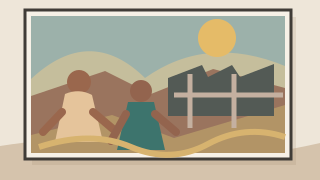
Diego Rivera was a Mexican painter and muralist whose frescoes depicted workers, industry, national history, and everyday life on monumental public walls.

David Alfaro Siqueiros was a Mexican painter and muralist known for using industrial materials and methods, including lacquer, enamel, pyroxylin, and automotive coatings.
Social Realism shares subjects with Mexican Muralism and the unsparing contemporary viewpoint of New Objectivity, but they remain separate histories.
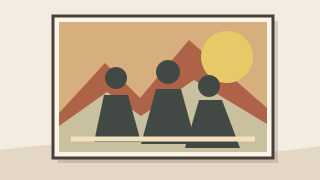
Mexican Muralism transformed large public walls into ambitious narratives of Mexican history, community, labor, and political change.
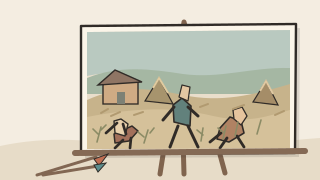
Realism emerged in nineteenth-century France as painters depicted ordinary people, rural labor, and contemporary life without idealization or heroic subjects.

New Objectivity developed in 1920s Germany as painters turned to unsentimental portraits and sharp observations of life during the Weimar Republic.