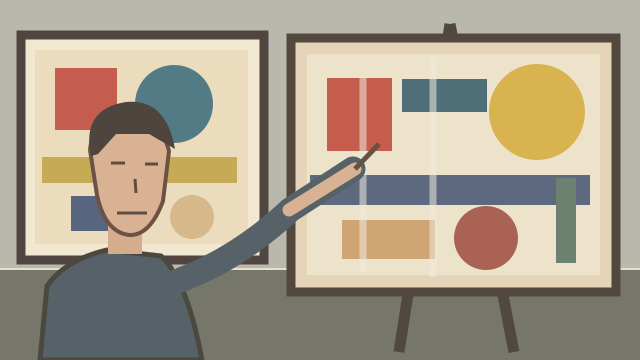
Sophie Taeuber-Arp
Sophie Taeuber-Arp was a Swiss Dada artist whose geometric abstractions moved between gouache, oil painting, textiles, and painted sculpture.
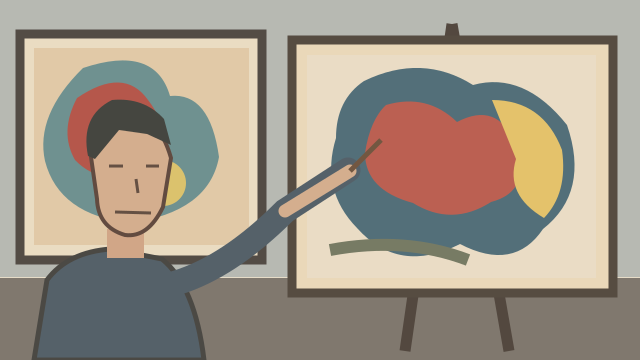
Painter
Jean Arp was a German-French Dada artist who shaped organic abstraction through chance collage, oil-and-cord canvases, and gouache studies in Paris.
Jean Arp helped shape Zürich Dada through chance-based collage and biomorphic forms, while his work ranged from painting and relief to sculpture.
| Full name | Hans Peter Wilhelm Arp |
|---|---|
| Born | 1886 · Strasbourg, German Empire (now France) |
| Died | 1966 · Basel, Switzerland |
| Nationality | German-French |
| Movements | Dada; Surrealism (association) |
| Paint types | Oil paint · Watercolor · Gouache · Metallic paint |
| Other media | Sculpture · collage |
| Other materials | — |
| Painting surfaces | Canvas · Paper · Board |
| Painting methods | Arranged paper shapes by chance and combined oil paint with lengths of cord; made gouache studies and cut-out gouache compositions on board |
| Common subjects | Abstract leaves, navels, organic shapes, imaginary heads, and silhouettes |
| Notable works | Two Heads · Leaves and Navels · Mountain, Navel, Anchors, Table · Untitled (Collage with Squares Arranged according to the Law of Chance) |
Sources: MoMA: Two Heads, oil and cord on canvas, MoMA: Leaves and Navels, oil and cord on canvas, MoMA: Mountain, Navel, Anchors, Table, gouache on board, MoMA: Gouache and pencil drawing for Le Siège de l'air, Guggenheim: Jean Arp biography, and National Galleries of Scotland: Jean Arp.
Arp combined oil with attached cord on canvas, used gouache for opaque cut-paper compositions, and made watercolor sheets and metallic-paint collages.

MoMA records Arp’s Two Heads (1927) as oil and cord on canvas. The painted forms share the surface with attached cord, so the picture combines painting with relief-like material. This work documents oil in his practice alongside the cut paper and collage associated with his Dada and biomorphic compositions.
Arp used gouache in works on board and paper. MoMA’s Mountain, Navel, Anchors, Table combines gouache on board with cutouts, while the MFAH records gouache on paper; the opaque medium lets him establish flat, vivid shapes before arranging or overlaying separate forms.
Arp also made watercolor works on paper, including examples in the Peggy Guggenheim Collection. These sheets use transparent color in a compact format distinct from his oil-and-cord canvas. Watercolor documents a painted medium in his practice, while many of his best-known compositions rely on cut and arranged paper.

The Peggy Guggenheim Collection records watercolor and metallic paint in Arp’s Large Collage. The reflective paint is used with transparent watercolor in a paper composition, not as metallic leaf or as a conventional oil medium. This specific mixed-media sheet documents his experimentation with surface and material.
Sources: MoMA: Two Heads (1927), oil and cord on canvas; MoMA: Mountain, Navel, Anchors, Table (1925), gouache on board with cutouts.; MFAH: Untitled, gouache on paper; Peggy Guggenheim Collection: Large Collage, watercolor and metallic paint; Centre Pompidou: Aquarelle interprétée n°2
Collection records show Jean Arp working on Canvas, Paper; the examples below distinguish painted supports from backing, collage, or sculptural components.
MoMA catalogs Arp’s Two Heads (1927) as oil and cord on canvas. The painting combines a conventional flexible support with attached cord, bringing painted shapes into shallow relief. This documented work distinguishes canvas from the paper and board surfaces used in his cutout compositions.
Arp used paper for watercolor and gouache works as well as collages. The MFAH records gouache on paper, and the Peggy Guggenheim Collection catalogs Large Collage with watercolor and metallic paint. These sheets document paper as both a painted support and a base for assembled forms.
Sources: MoMA: Two Heads, oil and cord on canvas, MoMA: Leaves and Navels, oil and cord on canvas, MoMA: Mountain, Navel, Anchors, Table, gouache on board, MoMA: Gouache and pencil drawing for Le Siège de l'air, Guggenheim: Jean Arp biography.
Taeuber-Arp collaborated with Arp on geometric compositions, while Max Ernst explored experimental collage across Dada and Surrealism in distinct ways.
Sophie Taeuber-Arp was a Swiss Dada artist whose geometric abstractions moved between gouache, oil painting, textiles, and painted sculpture.
Max Ernst was a German-born painter associated with Dada and Surrealism, known for uncanny scenes, collage, frottage, and scraped paint textures.