
Watercolor
Watercolor paint is a water-based art medium made with pigment and a water-soluble binder. It is known for transparent color that settles into absorbent paper.

Painter
Yayoi Kusama was a Japanese contemporary artist known for repeated dots and nets, immersive installations, mirrored environments, and recurring themes of infinity and self-obliteration.
Review key details about Yayoi Kusama's life, career, contemporary practice, major periods, and the recurring dots, nets, and immersive ideas that shaped her work.
| Born | March 22, 1929 · Matsumoto, Nagano, Japan |
|---|---|
| Died | August 14, 2026 · Tokyo, Japan |
| Nationality | Japanese |
| Movements | Pop Art, Minimalism, and Feminist art |
| Paint types | Watercolor · Gouache · Oil paint · Acrylic paint · Spray paint · Enamel paint · Urethane paint |
| Painting surfaces | Canvas · Paper · Painting board · Cardboard and paperboard · Fabric, including seed sacks |
| Painting methods | Allover repetition of hand-painted loops and dots, often built into thick, webbed impasto |
| Other media | Pastel, ink, sculpture, installation, performance, film, collage, and writing |
| Common subjects | Polka dots, infinity nets, pumpkins, flowers, eyes, mirrored spaces, and cosmic imagery |
| Notable works | Infinity Nets, Narcissus Garden, the Infinity Mirror Rooms, and the My Eternal Soul series |
Sources: Yayoi Kusama official biography, Whitney Museum of American Art, Whitney: Sprouting (The Transmigration of the Soul), MoMA: No. F., MoMA: The Atlantic Ocean, MoMA: Untitled (1978), Museum of Contemporary Art Tokyo: Chinese Rocks, The National Museum of Modern Art, Tokyo: Earth of Accumulation, and Yayoi Kusama Museum exhibition checklist.
See the paint types documented in Kusama's work, with links to PaintZeal references explaining each medium's properties, uses, and working characteristics.
Watercolor paint is a water-based art medium made with pigment and a water-soluble binder. It is known for transparent color that settles into absorbent paper.

Gouache paint is an opaque, water-based art medium made with pigment and a water-soluble binder. Traditional formulas dry to a matte finish and can be reactivated with water.

Oil paint is a slow-drying paint made with pigment and a drying oil binder. It is widely used for artwork because it blends smoothly and develops rich color.
Acrylic paint is a fast-drying, water-based paint made with pigment and an acrylic polymer binder. It is widely used in art and decorative projects because it is versatile and durable.

Spray paint is a liquid coating packaged in a pressurized can and applied as a fine aerosol. It creates an even finish without requiring a brush or roller.
Enamel paint is a broad category of coatings designed to form a hard and durable finish. Modern enamels may use either oil-based or water-based binders.
Polyurethane paint is a resin-based coating that forms a tough and durable finish. Formulas range from clear wood finishes to pigmented industrial coatings.
See the surface types documented in Kusama's work, with links to PaintZeal references explaining how each support behaves and is prepared for painting.

Paper is an absorbent sheet material made primarily from cellulose fibers. Its weight, sizing, surface texture, and wet strength determine how much paint it can accept before buckling, pilling, bleeding, or warping.
Canvas is a woven fabric support used for paintings, banners, bags, décor, and other projects. Artist canvas may be raw, sized, acrylic-primed, oil-primed, or factory-coated, and each condition changes how paint absorbs and bonds.

Painting board is a rigid artist support made from hardboard, wood, or another stable panel material. It may be sold raw or prepared with a medium-specific ground layer.

Cardboard is a paper-based sheet material made from compressed fibers, often with corrugated fluting between liner sheets. It is lightweight and absorbent, so heavy wet coats can soften or warp it.

Fabric is a flexible material made by weaving, knitting, or bonding fibers. Its fiber content, texture, stretch, and washability affect how paint bonds and wears.
Explore painters similar to Yayoi Kusama through repetition, optical pattern, bold graphic systems, serial imagery, and postwar experiments beyond conventional painting.

Andy Warhol was an American Pop artist known for transforming consumer products, celebrities, and mass-media photographs into paintings and repeated screen-printed images.
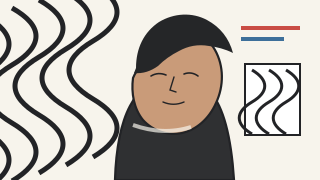
Bridget Riley is a British painter known for abstract compositions that create optical movement through repeated lines, curves, shapes, and structured color relationships.