Pablo Picasso
Pablo Picasso was a Spanish artist whose career ranged from the Blue and Rose periods through Cubism, Surrealism, sculpture, printmaking, and ceramics.
Painter
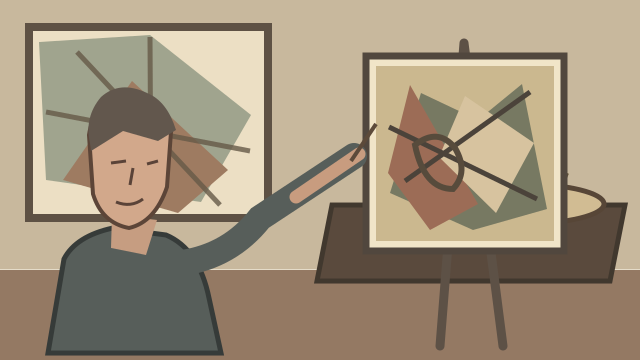
Georges Braque was a French painter who helped develop Cubism, combining fragmented still lifes with textured oil paint, stenciling, and paper collage.
Braque used decorative-painting skills to imitate wood and marble before introducing pasted wallpaper into Cubist drawings in 1912 as collage material.
| Full name | Georges Braque |
|---|---|
| Born | 1882 · Argenteuil, France |
| Died | 1963 · Paris, France |
| Nationality | French |
| Movements | Cubism · early Fauvism |
| Paint types | Oil paint · Watercolor · Gouache |
| Other media | Collage (papier collé) · drawing |
| Other materials | Printed wallpaper · sand |
| Painting surfaces | Canvas · Paper · Cardboard |
| Painting methods | Fragmented forms, stenciled lettering, simulated wood or marble, papier collé, and sand-textured oil painting |
| Common subjects | Guitars, violins, bottles, fruit, tables, interiors, birds, and landscapes |
| Notable works | Houses at l'Estaque · Violin and Palette · Fruit Dish and Glass · The Portuguese |
Sources: MoMA: Georges Braque, The Met: Still Life, oil and sand, The Met: Fruit Dish and Glass, Guggenheim Bilbao: Braque and his materials, SFMOMA: Georges Braque, and MoMA: Still Life with Tenora.
Braque used oil for Cubist canvases and gouache or watercolor on paper, while sand and pasted wallpaper became collage materials in his mixed-media work.

In Still Life: “2ᵉ étude” (early 1914), Braque combined oil, charcoal, and sand on unprimed canvas. He used imitation marble, stenciled text, and overlapping shapes to suggest a mandolin, bottle, newspaper, pipe, and glass without conventional depth. Sand supplied texture, but was an additive rather than another paint type.
Braque's Fruit Dish and Glass (autumn 1912) combines gouache and charcoal with cut-and-pasted wood-grain wallpaper on paper mounted to paperboard. One of his earliest papiers collés, it places commercially printed imitation wood beside drawing and opaque painted marks; the wallpaper is collage material, not paint.
Braque used watercolor on paper in works such as Still Life, recorded by the National Gallery of Art with gouache, graphite, and black chalk. He also used stenciled watercolor in his The Violin print, adding color to the repeated musical-instrument motif.
Sources: The Met: oil, sand, and charcoal in Still Life: “2ᵉ étude” and The Met: gouache and pasted wallpaper in Fruit Dish and Glass.; MoMA: Georges Braque; SFMOMA: Georges Braque; National Gallery of Art: Still Life, watercolor and gouache; MFA Houston: The Violin, stenciled watercolor; Detroit Institute of Arts: Guitar, crayon and watercolor
Collection entries identify canvas and paper among Georges Braque’s supports, with the examples below grounding each material in documented works.
Braque’s paintings include works on canvas, including oil paintings in MoMA’s collection. The textile support carries compositions made with paint and sometimes sand or stenciled lettering, distinct from the paper and cardboard used for collage. Museum records document canvas for both Cubist and later works.

Braque used paper for drawing, watercolor, and collage works. In Fruit Dish and Glass, paper is mounted to paperboard and combined with gouache, charcoal, and printed wallpaper. The sheet is the image-bearing support, while the pasted fragments are collage materials within the composition.

Braque’s papier collé works and selected paintings use cardboard as a support or collage ground. In Fruit Dish and Glass, the paper sheet is mounted to paperboard, providing a firm base for gouache, charcoal, and pasted wallpaper. This differs from canvas used for oil paintings.
Sources: MoMA: Georges Braque, The Met: Still Life, oil and sand, The Met: Fruit Dish and Glass, Guggenheim Bilbao: Braque and his materials, SFMOMA: Georges Braque.
Picasso and Braque developed early Cubism together, fracturing familiar objects and testing multiple viewpoints and collage materials in their paintings.
Pablo Picasso was a Spanish artist whose career ranged from the Blue and Rose periods through Cubism, Surrealism, sculpture, printmaking, and ceramics.