
Acrylic Paint
Acrylic paint is a fast-drying, water-based paint made with pigment and an acrylic polymer binder. It is widely used in art and decorative projects because it is versatile and durable.
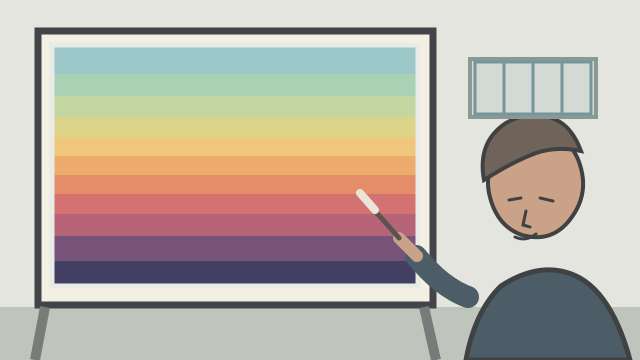
Painter
Norman Zammitt was a Canadian-born American Light and Space painter known for acrylic color-band canvases mixed to mathematical progressions of light.
Zammitt mixed calculated acrylic shades and arranged them into gradual bands, using color ratios and geometry to create luminous canvas paintings.
| Born | 1931 · Toronto, Ontario, Canada |
|---|---|
| Died | 2007 · Pasadena, California, U.S. |
| Nationality | Canadian-born American |
| Movements | Light and Space · Color field painting |
| Paint types | Acrylic paint · transparent and opaque pigments on glass and acrylic sheets (earlier work) |
| Painting surfaces | Canvas (large-scale band paintings) · Acrylic plastic sheets · glass (early transparent constructions) |
| Painting methods | Weighing five base colors into mathematically graduated mixes, then applying sequential hard-edge bands and seamless color transitions |
| Common subjects | Chromatic light, abstract gradients, horizon-like band arrangements, visual perception, and mathematically ordered color relationships |
| Color process | Computer-assisted logarithmic color calculations used to prepare 48 distinct shades from five source colors for selected works |
| Notable works | Search for the Elysian Field (1976) · Untitled (The Elusive Eureka) (1977–78) · Untitled (1984) |
Sources: LACMA: Untitled (1984), calculated 48 acrylic shades on canvas, LACMA: Untitled (The Elusive Eureka), acrylic on canvas, Palm Springs Art Museum: acrylic sheet sculptures and logarithmic color painting, Norton Simon Museum: paint on acrylic and glass, Light and Space context, Louis Stern Fine Arts: artist biography and Search for the Elysian Field, SFMOMA: Blue Burning and color-field painting, and Los Angeles Times: Toronto birthplace, U.S. citizenship, Pasadena death.
Acrylic paint allowed Zammitt to organize meticulously measured hues on canvas, while earlier translucent works explored paint on clear plastic.
Acrylic paint is a fast-drying, water-based paint made with pigment and an acrylic polymer binder. It is widely used in art and decorative projects because it is versatile and durable.
Large stretched canvases carried Zammitt's calculated bands of color; his early three-dimensional constructions used painted glass and acrylic sheets.
Canvas is a woven fabric support used for paintings, banners, bags, décor, and other projects. Artist canvas may be raw, sized, acrylic-primed, oil-primed, or factory-coated, and each condition changes how paint absorbs and bonds.

Plexiglass is a rigid acrylic sheet with a smooth, nonporous surface and sensitivity to incompatible solvents that can craze or damage the material.
Explore painters who make the perception of light, precisely arranged color, reflective supports, and optical changes central to their work.

Mary Corse is an American painter known for white acrylic paintings incorporating reflective glass microspheres that change in appearance with light and the viewer's position.

Roy Thurston is an American artist known for pigmented acrylic polyurethane and silicone coatings on milled aluminum panels that shift with reflected light.

Robert Irwin was an American artist whose oil paintings and sprayed acrylic discs led to pioneering work with light and perception in California.

Bridget Riley is a British painter known for abstract compositions that create optical movement through repeated lines, curves, shapes, and structured color relationships.