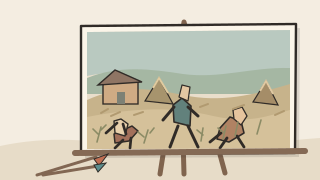
Realism
Realism emerged in nineteenth-century France as painters depicted ordinary people, rural labor, and contemporary life without idealization or heroic subjects.

Painting Movement
Photorealism emerged in the United States in the late 1960s, with painters using photographs to create detailed images of faces, storefronts, and everyday objects.
Its painters worked from photographic references, often emphasizing reflections, enlarged detail, sharp focus, and the visual qualities of ordinary scenes.
| Origin | United States, with early activity in New York and California |
|---|---|
| Approximate period | Late 1960s–1970s, with artists continuing to work afterward |
| Alternate spelling | Photo-realism; Hyperrealism is a related but broader and differently used term, not an exact synonym in every context |
| Defining approach | Painting from photographic source images while closely reproducing or selectively altering visual detail |
| Common subjects | City storefronts, cars, reflected light, portraits, consumer objects, and still lifes |
| Representative painters | Richard Estes, Chuck Close, Audrey Flack, Robert Bechtle, and Ralph Goings |
| Composition | Photographic framing, sharply focused surfaces, reflections, and sometimes combined viewpoints from several photographs |
| Working methods | Artists employed different methods, including gridding, airbrushing, and careful brush painting; not every painter used projection |
| Relationship to photography | Photographs provide working references, while the resulting artwork remains a painting with choices of scale, surface, and composition |
| Paint media | Oil paint and acrylic paint, depending on the artist and work |
| Painting surface | Canvas was used for major works, with other supports varying by artist |
Sources: Guggenheim: Photorealism, Guggenheim: Richard Estes, and Whitney: Chuck Close.
Estes studied city reflections, Close enlarged photographic portraits into monumental paintings, and Flack brought personal symbolism to detailed still lifes.
| Painter | Known for | Representative painting |
|---|---|---|
| Richard Estes | City scenes, storefront glass, and precise reflections | The Solomon R. Guggenheim Museum (1979) |
| Chuck Close | Monumental portraits enlarged from photographs using grids and detailed marks | Phil (1969) |
| Audrey Flack | Photograph-based still lifes and symbolic subjects with meticulously rendered surfaces | Macarena of Miracles (1971) |
Sources: Guggenheim: Estes's The Solomon R. Guggenheim Museum, Whitney: Close's Phil, and The Met: Flack's Macarena of Miracles.
Photorealism returned to recognizable subjects during an era of abstraction and Pop Art, but its reliance on photographic references gave it a distinct method.
Realism emerged in nineteenth-century France as painters depicted ordinary people, rural labor, and contemporary life without idealization or heroic subjects.

Pop Art drew on advertising, comic books, celebrities, and everyday products, bringing mass-media imagery into painting in Britain and the United States.
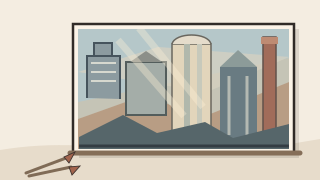
Precisionism emerged in the United States around 1920, using crisp geometric forms and smooth surfaces to depict factories, buildings, and everyday objects.