
Oil Paint
Oil paint is a slow-drying art medium made with pigment and a drying-oil binder that allows extended working time, smooth blending, and layered application.
Painting Movement
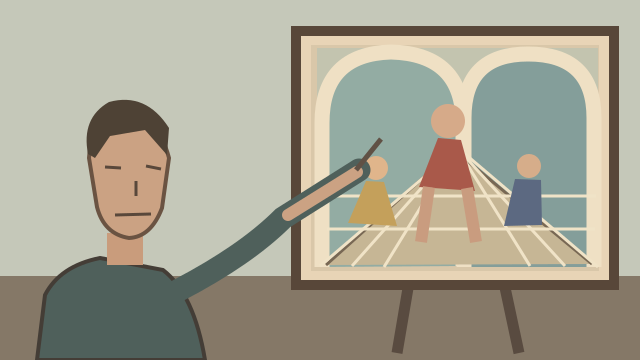
Renaissance painting developed across Europe as artists revived classical ideas, studied the human figure, and used perspective, light, and composition to create convincing spaces.
The Renaissance is a broad historical period and set of related artistic traditions, not one organized painters' group or a single painting technique.
| Origins | Italian cities, especially Florence, with related developments across Northern Europe |
|---|---|
| Approximate period | About 1400–1600 for Italian Renaissance painting; regional dates vary |
| Main phases | Early Renaissance and High Renaissance; Northern Renaissance describes related traditions north of the Alps |
| Influences | Classical Greek and Roman art, humanist learning, religious commissions, and close observation of nature |
| Defining characteristics | Balanced compositions, modeled figures, classical forms, measured perspective, and attention to anatomy and light |
| Common subjects | Christian stories, saints, portraits, mythology, classical figures, and historical narratives |
| Leading painters | Leonardo da Vinci, Michelangelo, Raphael, Sandro Botticelli, and Albrecht Dürer (Northern Renaissance) |
| Common methods | Underdrawing, linear perspective, oil glazing, tempera on prepared panels, and true fresco on damp plaster |
| Paint types | Oil paint and traditional tempera on portable supports; fresco is a separate wall-painting technique |
| Painting surfaces | Prepared wood panels, plaster walls and ceilings, and later canvas |
| Important distinction | Leonardo's Last Supper uses tempera-based paint on dry plaster, not traditional wet-plaster fresco |
| Legacy | Painting techniques and ideas about perspective, form, and classical subjects influenced European art for centuries |
Sources: National Gallery of Art: Italian Renaissance, National Gallery: Renaissance masterpieces, The Met: early tempera panel painting, and Last Supper museum: dry-plaster technique.
Oil paint and traditional tempera were important for portable Renaissance paintings. Fresco instead used mineral pigments on damp lime plaster; modern acrylics did not exist in Renaissance workshops.
Oil paint is a slow-drying art medium made with pigment and a drying-oil binder that allows extended working time, smooth blending, and layered application.

Traditional tempera is an artist paint made by combining pigment with an emulsion binder. Egg yolk is the best-known traditional binder, but the broader tempera category can include other emulsion recipes, so a museum record that says only “tempera” does not always identify the exact binder.
Leonardo, Michelangelo, and Raphael shaped High Renaissance painting. Botticelli was prominent in Florence, while Dürer developed an influential Northern Renaissance practice.

Leonardo da Vinci was an Italian High Renaissance painter whose portraits, subtle shadows, and carefully studied figures transformed European painting.

Michelangelo was an Italian High Renaissance artist renowned for sculptural human figures, the Sistine Chapel frescoes, and the Doni Tondo.

Raphael was an Italian High Renaissance painter celebrated for balanced Madonnas, clear figure groupings, and the Vatican's School of Athens fresco.

Sandro Botticelli was a Florentine Renaissance painter known for linear compositions, religious paintings, portraits, and mythological works including The Birth of Venus and Primavera.

Albrecht Dürer was a German Renaissance artist known for precise watercolors, drawings, engravings, and woodcuts that combined close observation with detailed technique.
Baroque painting followed the late Renaissance with dramatic light and movement. Neoclassicism later revived classical models, while Realism focused on contemporary subjects.
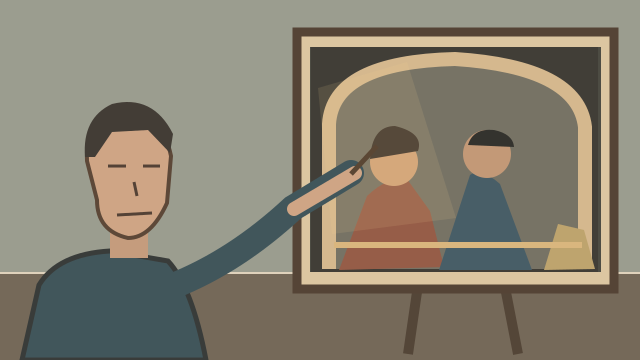
Baroque painting emerged around 1600 in Italy, bringing dramatic light, expressive figures, and immediate human emotion to religious and historical scenes while related styles developed across Europe.
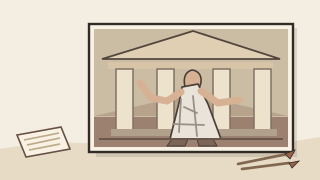
Neoclassicism emerged in eighteenth-century Europe, drawing on Greek and Roman art to create paintings with clear contours, balanced forms, and moral themes.
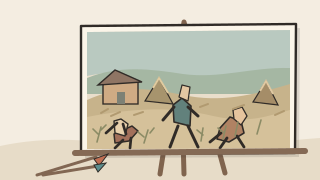
Realism emerged in nineteenth-century France as painters depicted ordinary people, rural labor, and contemporary life without idealization or heroic subjects.