Robert Vickrey
Robert Vickrey was a painter and illustrator known for egg-tempera works combining observation and symbolism, plus watercolor and gouache paintings.
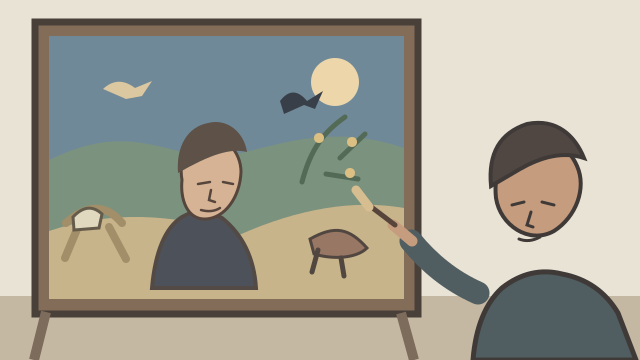
Painter
John Wilde was an American Magic Realist known for intricate oil paintings on wooden panels, depicting surreal figures, animals, and imagined worlds.
Wilde favored precise, meticulously rendered oil paintings on rigid wood supports, using knowledge of historic painting recipes and careful drawing.
| Born | 1919 · near Milwaukee, Wisconsin, U.S. |
|---|---|
| Died | 2006 · Cooksville, Wisconsin, U.S. |
| Nationality | American |
| Movements | Magic Realism · Surrealism |
| Paint types | Oil paint |
| Painting surfaces | Wood panels · Tempered Masonite boards |
| Painting methods | Meticulous detailed oil brushwork on rigid panels; self-prepared painting medium informed by Medieval and Renaissance recipes |
| Common subjects | Surreal human figures, self-portraits, animals, domestic interiors, still lifes, dream imagery, nature, love, and death |
| Other media | Graphite drawing, silverpoint, lithography and etching; not classified as paint |
| Notable works | Work Reconsidered #1 (1950) · In the Hand (1957) · Happy, Crazy, American Animals and a Man and Lady at My Place (1961) |
Sources: Smithsonian American Art Museum: biography and detailed oil painting, Smithsonian: Happy, Crazy, American Animals and a Man and Lady at My Place, oil on wood, Whitney Museum: Work Reconsidered #1, oil on wood, Pennsylvania Academy of the Fine Arts: In the Hand, oil on tempered Masonite and handmade medium, Madison Museum of Contemporary Art: Magic Realism and figurative style, Smithsonian Archives: life dates, Wisconsin and Magic Realism, and Estate gallery: Fruits of Winter, oil on board.
The documented paint types in John Wilde’s work include Oil; examples below connect each medium to a specific work and clarify its role in the image.

The Smithsonian records Happy, Crazy, American Animals and A Man and Lady at My Place as oil on wood. PAFA catalogs In the Hand as oil on tempered Masonite with a handmade medium whose exact formula is not specified. Together, these records document oil-based painting while preserving uncertainty about the latter work’s binder.
Sources: Smithsonian American Art Museum: Happy, Crazy, American Animals and a Man and Lady at My Place, oil on wood; Pennsylvania Academy of the Fine Arts: In the Hand, oil on tempered Masonite with handmade medium; Whitney Museum: Work Reconsidered #1, oil on wood.
Records identify John Wilde's use of wood and painting board, with named examples below showing how each support functions in the finished work.
The Smithsonian records Wilde’s Happy, Crazy, American Animals and A Man and Lady at My Place as paintings on wood. These compact panels carry his surreal, closely observed figures and objects; the museum records document wood as a direct support for finished paintings.

PAFA catalogs Wilde’s In the Hand as oil on tempered Masonite. This engineered wood-fiber panel is a rigid support distinct from the solid wood listed for other works; PAFA does not specify the exact binder of the handmade medium, so this row describes the board only.
Sources: Smithsonian American Art Museum: biography and detailed oil painting, Smithsonian: Happy, Crazy, American Animals and a Man and Lady at My Place, oil on wood, Whitney Museum: Work Reconsidered #1, oil on wood, Pennsylvania Academy of the Fine Arts: In the Hand, oil on tempered Masonite and handmade medium, Madison Museum of Contemporary Art: Magic Realism and figurative style.
Explore American Magic Realists with painstaking figurative painting, symbolic animals, imagined settings, and historically informed methods.
Robert Vickrey was a painter and illustrator known for egg-tempera works combining observation and symbolism, plus watercolor and gouache paintings.

George Tooker was an American painter known for egg-tempera scenes of offices, subways, and waiting rooms, often centered on isolation and social tension.

Jared French was an American painter known for precise egg-tempera pictures of figures and symbolic scenes, and associated with Magic Realism.

Paul Cadmus was an American painter known for figurative social satire, sustained egg tempera, and casein, watercolor, and gouache studies on paper.