
Oil Paint
Oil paint is a slow-drying art medium made with pigment and a drying-oil binder that allows extended working time, smooth blending, and layered application.

Painting Movement
Rococo flourished in eighteenth-century France, favoring graceful curves, light colors, intimate scenes of leisure, and playful garden or mythological subjects.
Rococo emerged from French court and interior decoration, influencing painting, architecture, and furnishings rather than belonging to a single painting academy.
| Approximate period | Early 1700s–1770s in France; timing differed elsewhere in Europe |
|---|---|
| Origin | France, especially Paris; decorative forms spread across Europe |
| French term | Rocaille (associated ornamental style); Rococo is the established broad label |
| Defining traits | Light colors, graceful movement, playful arrangements, curving forms, and intimate or decorative compositions |
| Typical subjects | Fashionable outdoor gatherings, fêtes galantes, idealized shepherds, mythology, courtship, and garden scenes |
| Historical paint | Oil paint for many finished works; documented watercolor and gouache in some artists' studies |
| Historical surfaces | Canvas for large paintings, wood for some smaller works, and paper for water-based studies |
| Key painters | Antoine Watteau, François Boucher, and Jean-Honoré Fragonard |
| Historical relationship | Followed some Baroque decorative traditions; later Neoclassicism favored different classical ideals and moral seriousness |
Sources: The National Gallery: Rococo to Revolution, 1700–1800, National Gallery of Art: François Boucher and Rococo, The Met: Watteau's French Comedians, oil on canvas, The Met: Boucher's gouache study, The Met: Fragonard's oil on wood.
Traditional Rococo paintings were primarily oils, with some watercolor and gouache studies. Modern acrylics, water-mixable oils, and acrylic gouache can also recreate delicate pastels, fabrics, and garden scenes without implying historical use.
Oil paint is a slow-drying art medium made with pigment and a drying-oil binder that allows extended working time, smooth blending, and layered application.

Water-mixable oil paint is oil paint made with modified drying oils that allow mixing and cleanup with water while retaining the working properties of traditional oils.

Acrylic paint is a fast-drying, water-based paint made with pigment and an acrylic polymer binder that forms a durable film on many prepared surfaces.

Watercolor paint is a water-based art medium made with pigment and a water-soluble binder, typically applied in transparent washes on absorbent paper.

Gouache paint is an opaque, water-based art medium made with pigment and a water-soluble binder, drying to a matte finish that can be reactivated with water.

Acrylic gouache is an opaque acrylic paint that dries to a flat matte finish while forming a permanent, water-resistant film unlike traditional gouache.
Watteau introduced graceful fêtes galantes, Boucher and Fragonard explored French mythological and romantic subjects, Nattier painted elegant court portraits, and Tiepolo and Longhi show contrasting sides of Venetian Rococo.

Antoine Watteau was a French painter whose elegant garden gatherings, theater figures, and tender fêtes galantes helped establish the Rococo style.

François Boucher was a French Rococo painter known for graceful mythological scenes, idealized pastoral settings, and lighthearted decorative commissions.

Jean-Honoré Fragonard was a French Rococo painter celebrated for playful romances, exuberant garden landscapes, and dazzling, loose oil brushwork.

Giovanni Battista Tiepolo was a Venetian Rococo painter celebrated for radiant ceiling frescoes, theatrical allegories, and expansive oil compositions.

Jean-Marc Nattier was a French Rococo portrait painter known for elegant aristocratic sitters, mythological costumes, and luminous oil-painted fabrics.

Pietro Longhi was a Venetian Rococo painter who depicted Carnival disguises, fashionable gatherings, and quietly comic moments of eighteenth-century city life.
Rococo adapted Baroque decorative energy toward lighter, more intimate scenes; Neoclassicism later favored formal restraint and antique models.

Baroque painting emerged around 1600 in Italy, bringing dramatic light, expressive figures, and immediate human emotion to religious and historical scenes while related styles developed across Europe.
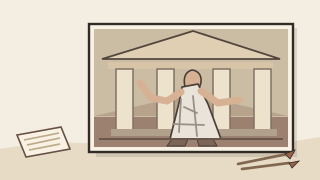
Neoclassicism emerged in eighteenth-century Europe, drawing on Greek and Roman art to create paintings with clear contours, balanced forms, and moral themes.